How to Pronounce Brevard County: Say It Like a LocalBy Stacey Buchanan, Broker-Owner of Melbourne RealtyBrevard County, Florida, is pronounced “bruh-VARD.” It has two syllables, with the
Dated: July 30 2026
Views: 78
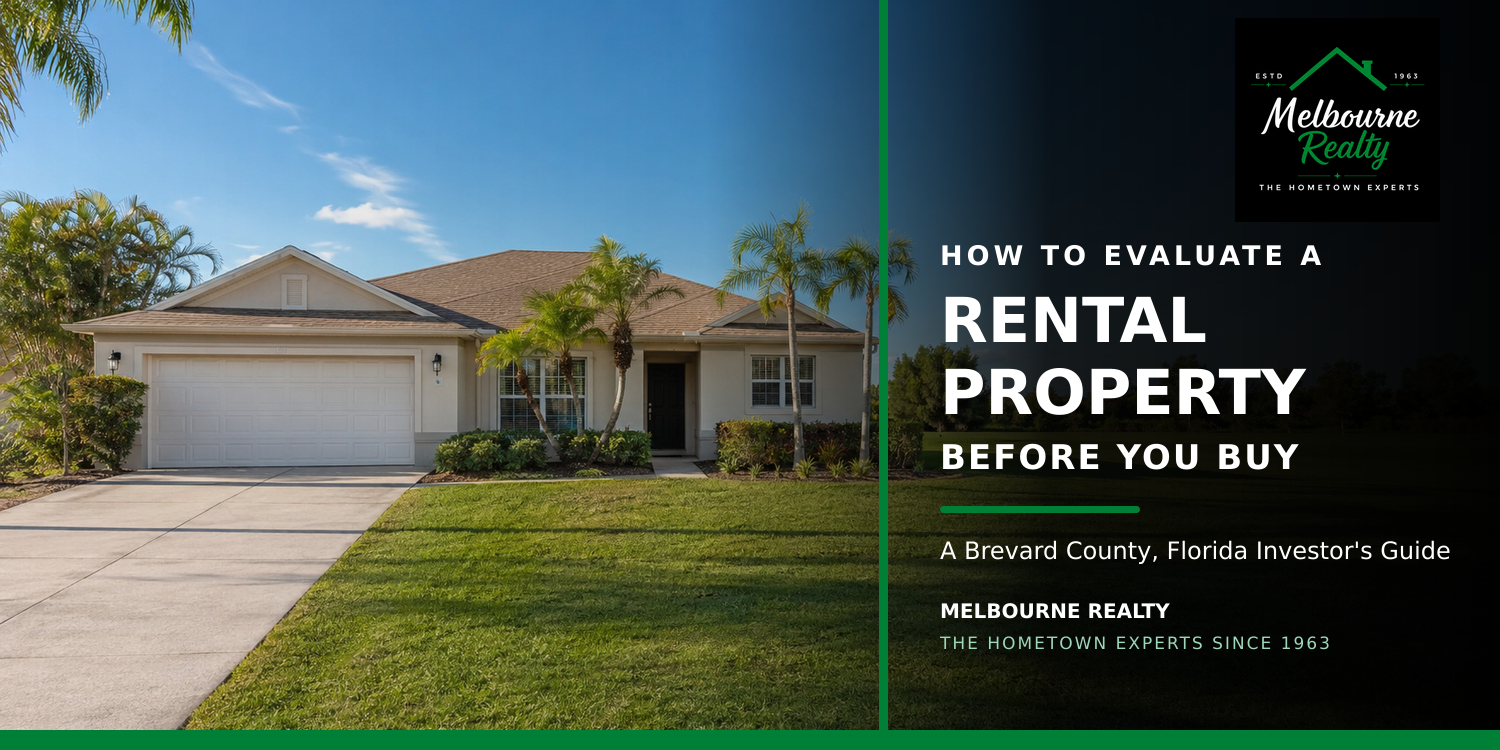
Buying a rental property can be an exciting way to build long-term wealth, but a low price does not automatically make a home a good investment.
The best decision comes from checking the location, rental demand, true cash flow, property condition, rules and long-term resale potential before you make an offer.
In Melbourne and throughout Brevard County, two nearby homes can have very different insurance costs, HOA restrictions, maintenance needs and rental demand. That is why a rental property should be evaluated like a small business—not only like a house.
To evaluate a rental property:
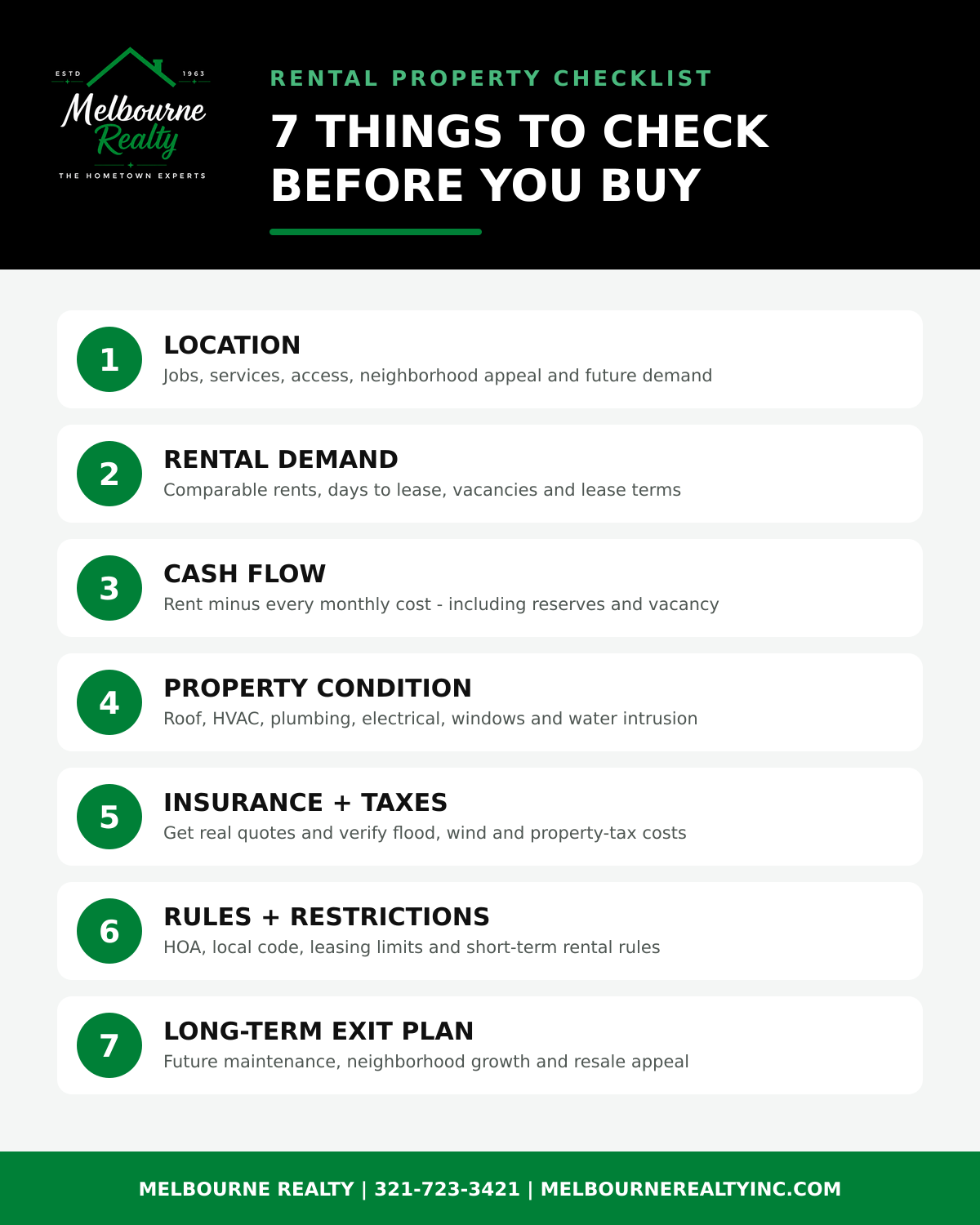
You have probably heard the phrase “location, location, location.” It matters just as much for an investment property as it does for a primary residence.
A desirable location can help a property attract tenants, reduce vacancies and maintain its resale appeal.
Look for practical features that support steady rental demand:
Visit the neighborhood at different times of day. Look at traffic, noise, drainage, nearby property condition and the route a future tenant would use for daily errands.
A house can look perfect during one showing and feel very different on a busy weekday evening.
Do not base your decision on one online rent estimate.
Ask a knowledgeable local real estate professional or property manager to compare the home with rentals that are truly similar.
Compare:
Also ask how long comparable rentals remain available and how frequently the area experiences vacancies.
Even a strong monthly rent can disappoint if the home sits empty longer than expected.
The purchase price and mortgage payment are only part of the cost.
A realistic rental-property analysis includes predictable monthly bills and reserves for expenses that do not happen every month.
Estimate all of the following:
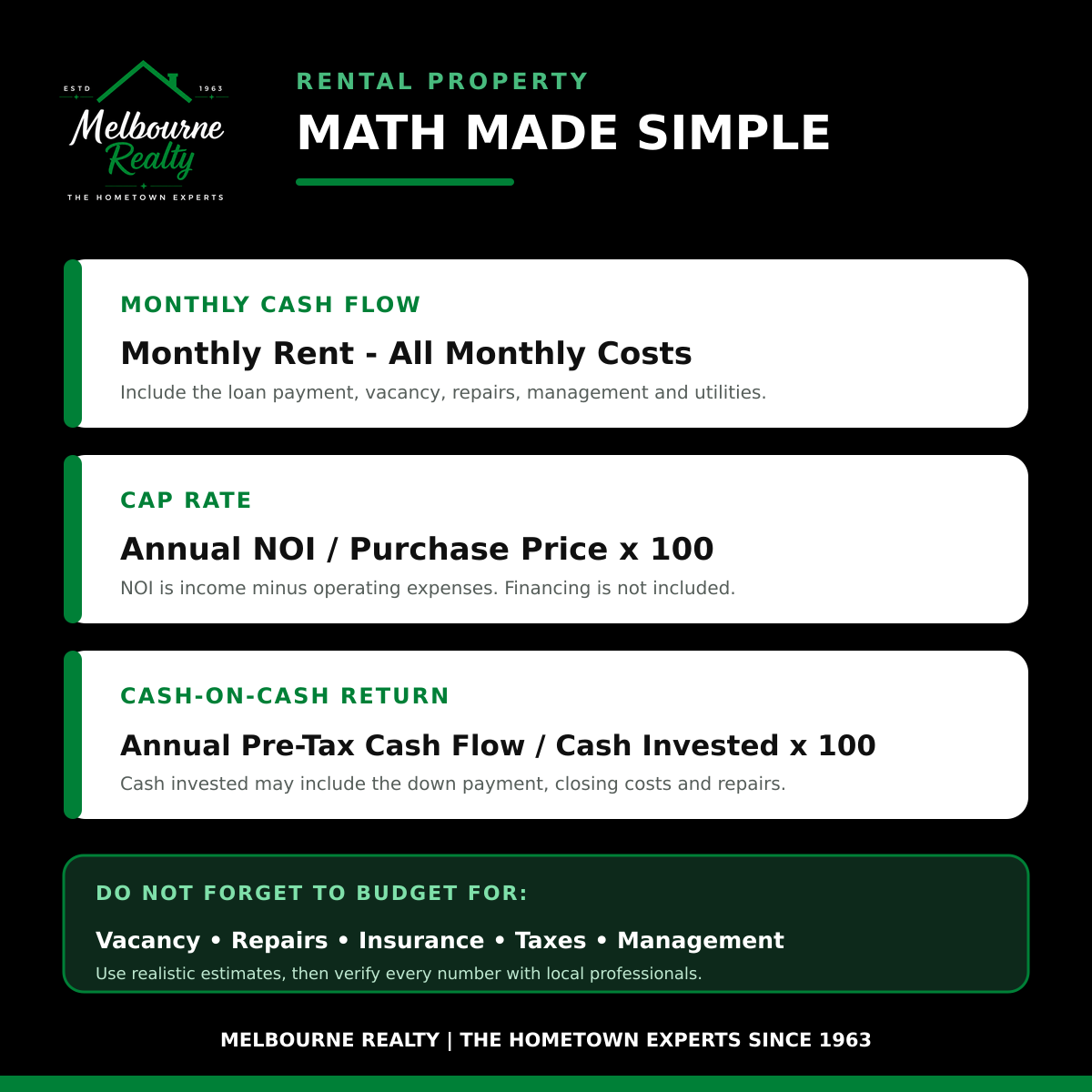
Monthly cash flow equals the rent collected minus every monthly cost.
Do not leave out vacancy, repairs or future capital expenses just because those bills are not due today.
Here is a simple example:
The rent sounded strong, but the complete calculation shows a very small cushion.
This example is for illustration only. Your actual expenses, loan terms, reserves and return goals will be different.
The capitalization rate, commonly called the cap rate, compares the property’s annual net operating income with its purchase price.
Net operating income is the rental income minus operating expenses. Financing costs are not included.
Cap rate = Annual net operating income ÷ Purchase price × 100
Cash-on-cash return compares the annual pre-tax cash flow with the amount of cash you invested.
The cash invested may include your down payment, closing costs and initial repairs.
Cash-on-cash return = Annual pre-tax cash flow ÷ Total cash invested × 100
No single formula tells the entire story. Use several measurements and compare the results with your goals, financing and comfort with risk.
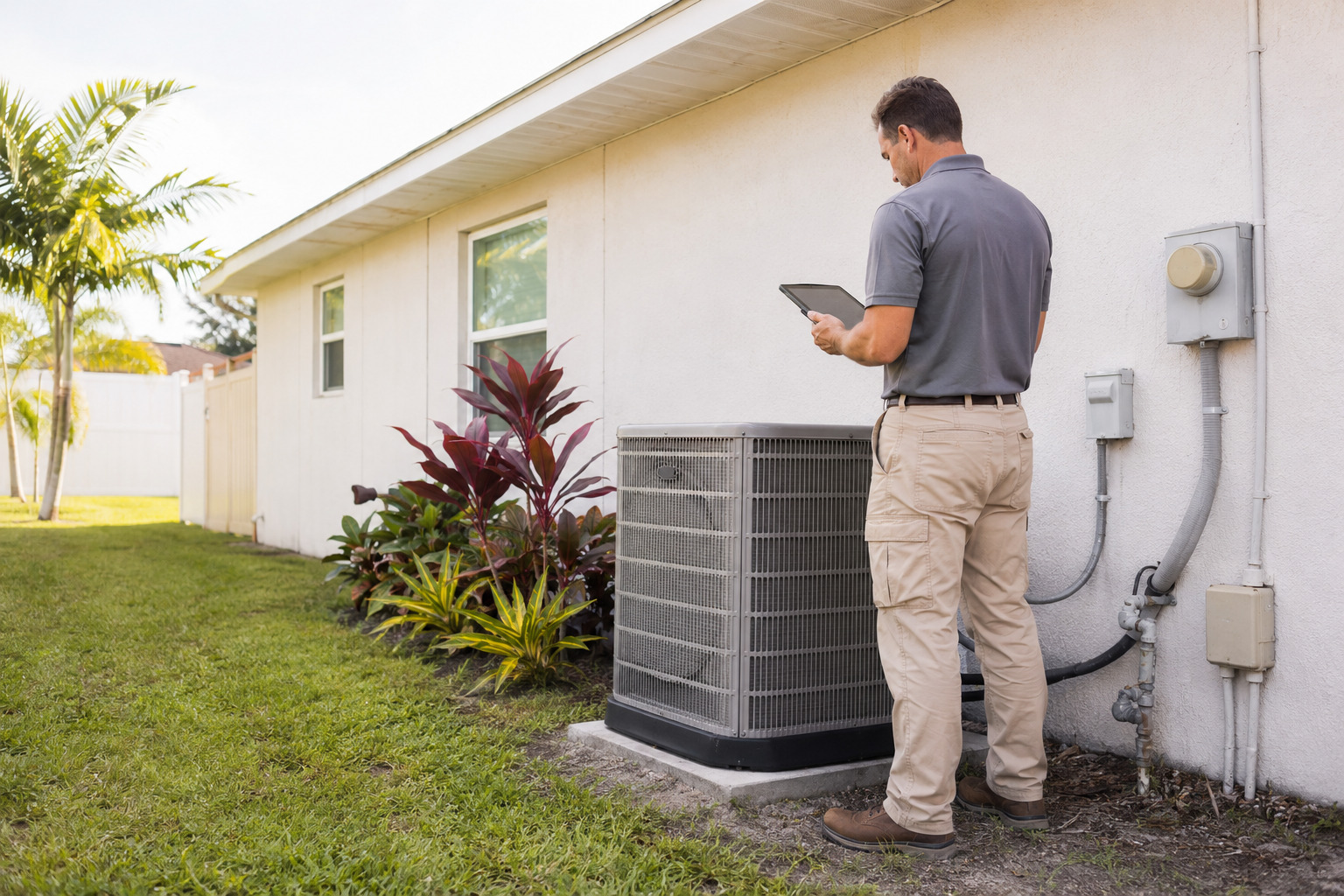
A thorough home inspection is essential.
Cosmetic updates are one thing. A roof, HVAC system or plumbing problem can change the investment quickly.
Pay special attention to:
In Florida, the age and condition of major systems can also affect insurance availability and price.
Get insurance quotes and repair estimates during the due-diligence period instead of relying on a rough guess.
Insurance and property-tax costs can have a major effect on cash flow.
Ask an insurance professional to quote the exact property using the available roof, wind-mitigation, four-point inspection and flood information.
Confirm the property’s current tax amount, but remember that a sale or change in use may affect future taxes.
If the property is in or near a flood-risk area, review official flood information and ask for a flood-insurance quote before deciding that the numbers work.
The seller’s current insurance premium is helpful background, but it does not guarantee what a new owner will pay.
Not every property can be rented the way you expect.
Rules may differ among Melbourne, other Brevard County municipalities, unincorporated areas, HOAs and condominium associations.
Before buying, verify:
Read the current rules yourself and obtain professional guidance when needed.
Do not assume that the current owner’s use guarantees that you can use the property the same way.
A good rental should make sense today and still have a reasonable future.
Ask whether the home’s layout, location and price point will likely remain useful to renters and future buyers.
Consider:
Appreciation can strengthen a long-term result, but it should not be used to rescue weak cash flow or ignored repair risk.
Rental-property decisions usually involve more than one professional.
The right team can help you verify important facts before small assumptions become expensive surprises.
Consider working with:
A strong rental property has supportable rent, manageable expenses, acceptable condition, legal rental use and a potential return that fits the buyer’s goals.
The lowest-priced home is not always the best investment.
Review comparable rentals with similar size, condition, amenities, lease terms and location.
Give more weight to recent leased properties and knowledgeable local feedback than to a single automated estimate.
There is no universal “good” cap rate.
It depends on the property type, location, condition, financing, growth expectations and risk. Use the cap rate as one comparison tool, not as the only reason to buy.
A fixer-upper may work when the purchase price, repair estimates, timeline and expected rent leave a reasonable financial cushion.
Get written estimates and include a contingency for unexpected expenses before committing.
No. Rules can vary by city, county area, condominium and HOA, and those rules may change.
Verify the current rules for the exact property address before buying.
Melbourne Realty has served local buyers, sellers and investors since 1963.
If you are considering a rental property in Melbourne or anywhere in Brevard County, we can help you compare available homes, review market rent and identify questions to investigate before you make an offer.
Call Melbourne Realty at 321-723-3421 or visit www.MelbourneRealtyInc.com.
This article provides general educational information and is not financial, tax, insurance or legal advice. Verify property-specific information and consult qualified professionals before making an investment decision.
Second Generation Broker-Owner34 Years ExperienceRamsey Trusted Real Estate ProCertified Real Estate Brokerage ManagerSeller Representative SpecialistAccredited Buyer Representativee-Pro Certified in ....
How to Pronounce Brevard County: Say It Like a LocalBy Stacey Buchanan, Broker-Owner of Melbourne RealtyBrevard County, Florida, is pronounced “bruh-VARD.” It has two syllables, with the
How to Evaluate a Potential Rental Property Before You BuyBuying a rental property can be an exciting way to build long-term wealth, but a low price does not automatically make a home a good
Many homeowners in Melbourne assume they only need to know their home’s value when they’re ready to sell.But here’s the truth: knowing your home value now gives you a powerful
Buying your first home can feel like trying to solve a puzzle with 1,000 pieces… but don’t worry. I’m going to hand you the picture on the box 🧩 so you can see exactly how it
 These listings are provided by the IDX Program of Brevard County, Florida. Real Estate listings held by brokerage firms other than Melbourne Realty are marked with the IDX Logo and detailed information about them includes the name of the listing brokers. IDX information is provided exclusively for consumers' personal, non-commercial use, and may not be used for any purpose other than to identify prospective properties consumers may be interested in purchasing. Information Deemed Reliable But Not
Guaranteed.
Copyright 2026 Space Coast Association of REALTORS, Inc
Show More...
These listings are provided by the IDX Program of Brevard County, Florida. Real Estate listings held by brokerage firms other than Melbourne Realty are marked with the IDX Logo and detailed information about them includes the name of the listing brokers. IDX information is provided exclusively for consumers' personal, non-commercial use, and may not be used for any purpose other than to identify prospective properties consumers may be interested in purchasing. Information Deemed Reliable But Not
Guaranteed.
Copyright 2026 Space Coast Association of REALTORS, Inc
Show More...
